Monroe County Job and Family Services
MOU
Memorandum of Understanding to Address Child Abuse and Neglect
Ohio Department of Children and Youth
MONROE COUNTY
MEMORANDUM OF UNDERSTANDING
TO ADDRESS CHILD ABUSE AND NEGLECT
I.	STATEMENT OF PURPOSE
This memorandum of understanding (hereinafter MOU) to address child abuse and neglect is required by sections 2151.4220, 2151.4221, 2151.4222, 2151.4223, 2151.4225, 2151.4226, 2151.4228, 2151.4229, 2151.4230, 2151.4231, 2151.4232, 2151.4233, and 2151.4234 of the Ohio Revised Code and rule 5180:3-1-26 of the Ohio Administrative Code.  It is an agreement among Monroe County Department of Job and Family Services (hereinafter PCSA) and community partners that delineates roles and responsibilities for referring, reporting, investigating, and prosecuting child abuse and neglect cases within Monroe County (hereinafter county). The MOU also identifies procedures for collaborative service provisions needed to ensure child safety, permanence, and well-being, and the minimum requirements of screening, assessment/investigation, and service planning, to meet mandates included in children services legislation passed by the 134th Ohio General Assembly.  Two primary goals of this MOU are:
- The elimination of all unnecessary interviews of children who are the subject of reports of child abuse or neglect.
- When feasible, conducting only one interview of a child who is the subject of a report of child abuse or neglect.
Throughout the state each PCSA provides the following services to their communities:

Screening: The capacity to accept and screen referrals of suspected child abuse, neglect, and/or dependency includes but is not limited to the following: Receiving referrals 24 hours/day, 7 days/week; Recording and retaining referral information; Following Ohio’s screening guidelines based on Ohio Administrative and Revised Code and categorizing the child maltreatment type; Adherence to a protocol for making screening and differential response pathway decisions regarding referrals of suspected child abuse, neglect, and/or dependency within 24 hours from the time of the referral; Documenting case decisions; And assigning a response priority of emergency or non-emergency to any screened in report.

Assessment and Investigation: The capacity to investigate and assess accepted reports of suspected child abuse, neglect, and/or dependency, includes responding to emergency reports within one (1) hour and non-emergency reports within twenty-four (24) hours; Conducting an initial Safety Assessment using a standardized CAPM (Comprehensive Assessment Planning Model) tool within the timeline prescribed in the Ohio Administrative Code; Completing a more in-depth CAPM Family Assessment including a clinical and actuarial risk assessment within sixty (60) days;  Working collaboratively with other investigative agencies when appropriate; Making traditional response case dispositions within required timeframes; Evaluating the need for protective, prevention, or supportive services and/or court involvement; and documenting all activities and case determinations.

Service Provision: The capacity to provide services that ameliorate, eliminate, or reduce future child maltreatment and the conditions which led to abuse, neglect, or dependency includes providing service planning and case management coordination; Identifying and stating the concern and behavior change(s) needed for reunification to occur through the use of the CAPM Family Case Plan; Monitoring the family’s case progress, measuring service outcomes, re-assessing safety and risk, and evaluating permanency options by using the CAPM Case Review and Semi-Annual Review tools; And adhering to existing visitation, documentation, and case closure protocols.

II.	ROLES AND RESPONSIBILITIES OF EACH PARTICIPATING AGENCY

A.	CDJFS/PCSA (If a combined agency or stand-alone PCSA)

The PCSA is the lead agency for the investigation of child abuse, neglect, or dependency in the county. The PCSA will coordinate and facilitate meetings, establish standards and protocol for joint assessment/investigation with law enforcement, cross-referrals, confidentiality, and training of signatories as required by statute. Child Protective Services staff and management will also participate in meetings and trainings as deemed appropriate at the discretion of the Director.

B.	LAW ENFORCEMENT

The county peace officer, each Chief of the local political subdivisions, and any other law enforcement officers handling child abuse and neglect cases in the county will have responsibility for: taking referrals/reports alleging child abuse and neglect from any source within their respective jurisdiction; Referring reports to the PCSA as soon as possible or within 24 hours for investigation of the circumstances; Determining whether allegations of abuse or neglect rise to the level of criminal conduct; Cooperating with the PCSA in a joint and thorough investigation when the information contained in the report lends itself to allege a present danger; Assisting the PCSA in hazardous situations where the provision of protective services or the investigation of child abuse or neglect is impeded; Coordinating with the PCSA on interviews with principals of the case when there are serious criminal implications; Notifying the PCSA of any legal action involving an alleged perpetrator of child abuse or neglect; Responding to the PCSA’s requests for information regarding the status of the legal action; Providing police record checks for the PCSA as necessary or requested as permitted by law; Consulting with the PCSA prior to removal of a child from their home when possible; Handling and coordinating investigations involving a child fatality or near fatality which may have resulted from abuse or neglect.

C.	JUVENILE COURT
The most senior Juvenile Judge in point of service of the county or their representative, selected by the Judge, if more than one, will be responsible for attending meetings concerning the MOU, entering into agreements with the other signatories of the MOU regarding the court’s responsibility to timely hear and resolve child abuse, neglect, and dependency matters, signing the MOU, and updating the MOU or approving any amendment.

The juvenile court has a duty to exercise jurisdiction over adults and children to hear and decide matters as permitted by the Ohio Revised Code Chapters 2151 and 2152.  The court is responsible for issuing orders regarding the care, protection, health, safety, mental and physical best interest of children. The Juvenile Judge will ensure that due process of law is achieved; Hear evidence and issue findings of fact and conclusions of law as to any abused, neglected, or dependent child; Order timely and safe permanency dispositions for children; Preserve the family environment whenever possible while keeping the child(ren)'s health and safety paramount.

D.	COUNTY PROSECUTOR

The County Prosecutor will report suspected cases of child abuse and neglect to the PCSA or appropriate law enforcement agency. The County Prosecutor will represent the PCSA in legal actions to protect a child from further harm resulting from child abuse or neglect unless the Prosecutor has granted consent for the appointment of an In-house PCSA Attorney pursuant to Ohio Revised Code chapters 309 and 305.

The prosecuting attorney may inquire into the commission of crimes within the county. The prosecuting attorney will prosecute, on behalf of the state, all complaints, suits, and controversies in which the state is a party, except for those needing to be prosecuted by a special prosecutor or by the attorney general.  The County Prosecutor is to determine, based upon the facts, whether criminal culpability exists and if enough evidence exists for a matter to be prosecuted. The prosecutor will be available to law enforcement and the PCSA staff for questions or assistance in the investigation of child abuse and neglect cases and eliminate the need for testimony at the municipal court level by allowing for direct presentation to the Grand Jury, when feasible, to minimize trauma to child victims. The prosecuting attorney agrees to aid the PCSA in protecting the confidential nature of children services records and investigations; As well as the special protection afforded to the identity of the reporting source.

E.	COUNTY DEPARTMENT OF JOB & FAMILY SERVICES [If not part of a combined agency]
1 Not Applicable (if selected, this section is not relevant.)

If the county’s Department of Job and Family Services is a separate agency from the PCSA, employees within the county agency are expected to report suspected cases of child abuse and neglect to the PCSA or appropriate law enforcement agency upon receipt; Collaborate with the PCSA to assist families in caring for their children; Assure that children at risk of abuse and neglect receive protective services; Assure service coordination for families already involved with the PCSA; Promote ongoing communication between the county’s Department of Job and Family Services and the PCSA regarding mutual clients, including minors under the protective supervision or in the custody of the Agency and/or minor parents; Assist the PCSA upon request in obtaining case or assistance group information regarding a family when the PCSA is assessing Title IV-E eligibility or completing an assessment/investigation of a child at risk or alleged to be abused; Assist the PCSA in obtaining addresses and attempts to locate parents whose whereabouts are unknown, pursuant to OAC 5180:2-33-28; And where applicable and permitted assist the PCSA in locating suitable relatives or kin that may be available as familial support for the child(ren) or as a placement option.

E.	LOCAL ANIMAL CRUELTY REPORTING AGENCY

The local animal cruelty reporting agencies are to investigate reports of animal abuse and neglect within the county and, pursuant to ORC 2151.421, report suspected cases of child abuse and neglect that may be observed during the commission of their duties to the PCSA or local law enforcement.

G. 	CHILDREN’S ADVOCACY CENTER (Needs to be included if agreement with CDJFS/PCSA exists.  Option to skip this section if your agency does not have a formal agreement with a children’s advocacy center.)
0 Not Applicable (if selected, this section is not relevant.)

The Children’s Advocacy Center (CAC) will establish internal protocols regarding the investigation of CAC cases, participate in training as needed, work jointly and cooperatively in their established role with the other team members in the investigation of CAC cases, and attend and exchange information when meeting with the PCSA, law enforcement, and other signatories of this agreement.

H.	CLERK OF COUNTY COMMON PLEAS COURT (Optional per statute, but benefits to inclusion should be considered per county.  If the Clerk signs this MOU, the Clerk will execute all relevant responsibilities as required of officials specified in this MOU.)
1 Not Applicable (if selected this section is not relevant.)

The Clerk of County Common Pleas Court will collaborate with the PCSA, County Prosecutor, and local law enforcement to establish standards and processes for the filing and acceptance of abuse, neglect, and dependency pleadings; Notice to the necessary parties; Service of process; How to send and receive communications from the Clerk; Defining acceptable methods of communication; Best practices for handling emergency/ex parte motions and orders which require the removal of children and need to be acted upon in an expeditious manner; Date and timestamp process and any cut-offs; Determine how and when to expect decisions or entries to be communicated; Provide periodic training for those involved in the investigation of child abuse and neglect and the signatories of this MOU; Be available to the PCSA management staff or the Prosecutor should questions arise.

III.	SCOPE OF WORK
The key objective of this MOU is to clearly define the roles and responsibilities of each agency in the provision of child protective services.

A.	Mandated reporters and penalty for failure to report

Persons identified as mandated reporters per Ohio Revised Code section 2151.421, while acting in official or professional capacity, will immediately report knowledge or reasonable cause to suspect the abuse or neglect of a child in accordance with that section.  Reports will be made to the PCSA or a law enforcement officer.

The penalty for the failure of a mandated reporter to report any suspected case of child abuse and/or neglect pursuant to ORC section 2151.421 is a misdemeanor of the fourth degree.  The penalty is a misdemeanor of the first degree if the child who is the subject of the required report that the offender fails to make suffers or faces the threat of suffering the physical or mental wound, injury, disability or condition that would be the basis of the required report when the child is under the direct care or supervision of the offender who is then acting in the offender’s official or professional capacity or when the child is under the direct care or supervision of another person over whom the offender, while acting in the offender’s official or professional capacity, has supervisory control. Failure to report suspected child abuse and/or neglect may also result in civil liability in the form of compensatory or exemplary damages.

If a mandated reporter fails to report their suspicions of abuse or neglect of a child, this information will be forwarded to the Monroe County Prosecutor’s Office upon receipt of the information both via a phone call and followed up in writing via an email.

B.	System for receiving reports

Reports of child abuse or neglect will be made to the PCSA or any law enforcement officer with jurisdiction in the county. If the PCSA contracts with an outside source to receive after-hour calls, a copy of the signed agreement will be attached to this MOU which indicates that all reports with identifying and demographic information of the reporter and principals will be forwarded to a designated children services worker within an hour of receipt, confidentiality requirements will be met, and how the public is informed of after-hours reporting opportunities.

When a law enforcement officer receives a report of possible abuse or neglect of a child or the possible threat of abuse or neglect of a child, the law enforcement officer will refer the report to the appropriate PCSA unless an arrest is made at the time of the report that results in the appropriate PCSA being contacted concerning the alleged incident involving the child.

When the PCSA screens in a report of child abuse, the PCSA will notify the appropriate law enforcement agency of the report, unless law enforcement is present and an arrest is made at the time of the report that results in the appropriate law enforcement agency being notified of the child abuse.

When the PCSA screens in a report of child neglect, and the PCSA implements a legally authorized out-of-home placement due to neglect within the first seven days of the assessment/investigation, the PCSA will notify the appropriate law enforcement agency within the first seven days of the assessment/investigation unless an arrest is made at the time of the report that results in the appropriate law enforcement agency being notified of the child neglect.

C.	Responding to mandated reporters

When the PCSA receives a referral from a mandated reporter who provides their name and contact information, the PCSA will forward an initial mandated reporter notification to the referent within seven days.  The notification will be provided, in accordance with the mandated reporter’s preference.  Information shared with the mandated reporter will include the information permitted by ORC 2151.421(K):
- Whether the agency or center has initiated an investigation of the report;
- Whether the agency or center is continuing to investigate the report;
- Whether the agency or center is otherwise involved with the child who is the subject of the report;
- The general status of the health and safety of the child who is the subject of the report;
- Whether the report has resulted in the filing of a complaint in juvenile court or of criminal charges in another court.
When the PCSA closes an investigation/assessment reported by a mandated reporter, the PCSA will forward a mandated reporter referral outcome notification to the referent.  The notification will be provided in accordance with the mandated reporter’s preference.  Information shared with the mandated reporter will be that permitted by ORC 2151.421 to include a notification that the agency has closed the investigation along with a point of contact.

D.	Roles and responsibilities for handling emergency cases of child abuse, neglect, and dependency

1.	PCSA’s Response Procedure

When the PCSA determines that a report is emergent, the PCSA will attempt a face-to-face contact with the child subject of the report/ alleged child victim within one hour of the receipt of the report.

If the PCSA identifies an active safety threat at any point during the assessment/investigation, the caseworker or supervisor will implement a safety response.

Monroe County will implement either an in home or out of home safety plan. An out of home safety plan will at times include a filing of an Abuse/Neglect/Dependency complaint in Juvenile Court.


2.	Law Enforcement and Harmony House Response Procedure

Referrals will be made to Harmony House and law enforcement as soon as possible.  Law enforcement will be made aware of the scheduled Harmony House interviews within 24 hours so that can attend the interviews. The appropriate law enforcement agency will be notified of the scheduled interviews to afford them the opportunity to attend the interviews.  If they cannot attend the interview a copy of the audio and video taped interview will be provided to them by Monroe County DJFS.

3.	Children in Need of Medical Attention Special Response Procedures

When children need medical services, Monroe County DJFS will assist the family in receiving emergency services. The cases that involve sexual abuse, Monroe County DJFS utilizes SANE nurses either through Cambridge or Barnesville Hospitals

E.	Standards and procedures to be used in handling and coordinating investigations of reported cases of child abuse and/or neglect

Methods to be used in interviewing the child who is the subject of the report and who allegedly was abused and/or neglected, alleged perpetrators, and other family members and witnesses/collaterals will be discussed and agreed upon in advance by the PCSA and the corresponding law enforcement agency.

To the extent possible investigative interviews of children who are the alleged victims of reports of abuse and/or neglect where criminal activity is suspected, including reports of human trafficking, are cooperatively planned by the PCSA and the law enforcement agency of the jurisdiction.

Every effort will be made by the signatories of this MOU to prevent or reduce duplicate interviews of the victims or witnesses.  When feasible, to reduce trauma complete only one interview with the alleged child victim/ child subject of the report.  The PCSA agrees to be the lead agency in scheduling the time, place, and location of joint interviews as well as notifying all participants.

Before starting the interview, the participants will determine who is to be present in the room, who will be asking the questions, what areas are to be covered, and who will be the scribe for the interview. Audio and video recordings may be used when necessary.

When law enforcement or the prosecutor’s office interviews a participant in a criminal investigation and a representative of the PCSA is not present, the interviews conducted by law enforcement or the prosecutor's office may be used by the PCSA to meet the agency investigative requirements set forth in rule. Law enforcement or the prosecutor’s office will forward a written summary of the interview to the PCSA upon request.

The PCSA agrees not to proceed without the advice and consent of the prosecutor’s office when a criminal investigation is being conducted concurrently. The PCSA will not jeopardize a criminal investigation but will work with law enforcement to protect the safety of the child victim or witnesses. Law enforcement will be the lead agency in the collection of forensic evidence and will coordinate with the necessary facilities to obtain and store such evidence properly.

The PCSA will follow up with law enforcement to ensure timely assistance and to complete mandated assessment/investigation activities within the sixty-day timeframe.

F.	Standards and procedures addressing the categories of persons who may interview the child who is the subject of the report and who allegedly was abused or neglected

The categories of personnel who may conduct interviews of children who are the subjects of reports of alleged abuse, neglect, and/or dependency are limited to the following:
- Casework and supervisory staff of the PCSA
- Law enforcement personnel
- County or city prosecuting attorneys, assistant prosecuting attorneys, in-house JFS legal counsel if applicable, and their investigative staff
- Harmony House Staff
G.	Standards and procedures for PCSA requests for law enforcement assistance

The PCSA may request the assistance of law enforcement during an assessment/investigation if one or more of the following situations exist:
- An exigent circumstance.
- The PCSA has reason to believe that the child is in immediate danger of serious harm.
- The PCSA has reason to believe that the worker is, or will be, in danger of harm.
- The PCSA has reason to believe that a crime is being committed, or has been committed, against a child.
- The PCSA worker needs to conduct a home visit after regular PCSA business hours, and a law enforcement escort is requested as a standard operating procedure.
- The PCSA is removing a child from his or her family via an order of the court, and the assistance of law enforcement is needed as the PCSA has reason to believe the family will challenge the removal.
- The PCSA is working with a client who has a propensity toward violence, and the assistance of law enforcement is needed to ensure the safety of all involved.
- The PCSA is working with a family that has historically threatened to do harm to PCSA staff.
H.	Specialized Investigations or Circumstances

To the extent possible, investigative interviews of children who are the alleged child victims/child subjects of the report of abuse and neglect where criminal activity is suspected, including reports of human trafficking, physical and sexual abuse, domestic violence, child endangering, or the like, are cooperatively planned by the PCSA and the law enforcement agency of jurisdiction.

1.	Out-of-Home Care

The PCSA conducts an out-of-home care investigation in response to a child abuse or neglect report that includes an alleged perpetrator who meets one or more of the following criteria:
- Is a person responsible for the alleged child victim’s care in an out-of-home care setting as defined in rule 5180:2-1-01 of the Administrative Code.
- Is a person responsible for the alleged child victim’s care in out-of-home care as defined in section 2151.011 of the Revised Code.
- Has access to the alleged child victim by virtue of their employment by or affiliation to an organization as defined in section 2151.011 of the Revised Code.
- Has access to the alleged child victim through placement in an out-of-home care setting.
The PCSA follows the procedures for conducting out-of-home care investigations as described in section 5180:2-36-04 of the OAC.


2.	Third-Party Investigations

In accordance with section 5180:2-36-08 of the OAC, the PCSA is to  request a third-party in the assessment/investigation for reports of child abuse or neglect where there is potential for a conflict of interest because one of the following parties is a principal of the report:
- Any employee of an organization or facility that is licensed or certified by the Ohio Department of Children and Youth (DCY) or another state agency and supervised by the PCSA.
- A foster caregiver, pre-finalized adoptive parent, adoptive parent, relative, or kinship caregiver who is recommended, approved, or supervised by the PCSA.
- A type B family childcare home or type A family childcare home licensed by DCY when the CDJFS has assumed the powers and duties of the county children services function defined in Chapter 5153. of the Revised Code.
- Any employee or agent of DCY or the PCSA as defined in Chapter 5153. of the Revised Code.
- Any authorized person representing DCY or the PCSA who provides services for payment or as a volunteer.
- A foster caregiver or an employee of an organization or facility licensed or certified by DCY and the alleged child victim is in the custody of, or receiving services from, the PCSA that accepted the report.
- Any time a PCSA determines that a conflict of interest exists. The PCSA is to document in the case record if a conflict of interest is identified.
The PCSA is to request that law enforcement serve as the third party when a report alleges a criminal offense.  The PCSA is to request the assistance of a third party within 24 hours of identifying that a conflict of interest exists.


3.	Child Fatality- Suspected cause of death is abuse or neglect

The PCSA is governed by ORC section 307.622 and needs to have a child fatality review board.

Upon receipt, all child fatality reports received by Monroe County DJFS will be reported to the appropriate law enforcement agency.  Monroe County DJFS will work cooperatively and share information with the identified law enforcement Agency.


4.	Child Fatality- Death of a child in the custody of the PCSA

The PCSA follows rules 5180:2-33-14 and 5180:2-42-89 of the OAC following the death of a child in its custody.

5.	Allegations of withholding medically indicated treatment from disabled infants with life-threatening conditions

The PCSA follows the procedures described in section 5180:2-36-07 of the OAC for responding to these reports.

The withholding of medically indicated treatment is the refusal to provide appropriate nutrition, hydration, medication, or other medically indicated treatment from a disabled infant with a life-threatening condition.

Medically indicated treatment includes the medical care most likely to relieve, or correct, the life-threatening condition.  Nutrition, hydration, and medication, as appropriate for the infant’s needs, are medically indicated for all disabled infants; in addition to, the completion of appropriate evaluations or consultations necessary to assure that sufficient information has been gathered to make informed medical decisions on behalf of the disabled infant.

In determining whether treatment is medically indicated, reasonable medical judgments made by a prudent physician, or treatment team, knowledgeable about the case and its treatment possibilities are considered.  The opinions about the infant’s future “quality of life” are not to bear on whether a treatment is judged to be medically indicated.  Medically indicated treatment does not include the failure to provide treatment to a disabled infant if the treating physician’s medical judgment identifies any of the situations listed in OAC section 5180:2-36-07(A)(3)(a-d).

The Agency maintains contact numbers for all appropriate health care facilitates, in the office and programed into the after-hours emergency on call phone.


6.	Allegations of child abuse and/or neglect constituting a crime against a child, including human trafficking, and needing a joint assessment/investigation with law enforcement

The Agency will work closely with law enforcement and the safety of the child(ren) will be paramount when making decisions regarding each case.
7.	Reports of cases involving individuals who aid, abet, induce, cause, encourage, or contribute to a child or a ward of the juvenile court becoming dependent, neglected, unruly, and/or delinquent

The Agency will complaints as deemed appropriate on a case-by-case basis.  The Agency will seek assistance from law enforcement when necessary.

8.	Reports involving individuals who aid, abet, induce, cause, encourage, or contribute to a child or a ward of the juvenile court leaving the custody of any person, department, or public or private institution without the legal consent of that person, department, or institution

The Agency will file complaints as deemed appropriate on a case-by-case basis.  The Agency will seek assistance from law enforcement when necessary

9.	Receiving and responding to reports of missing children involved with the PCSA

Upon learning that a minor child has either run away from or is otherwise missing from the home or the care, custody, and control of the child’s parents, custodial parent, legal guardian, or non-custodial parent, the following actions will take place:
- When an MOU signatory agency is made aware that a child is missing, they will coordinate with the custodian to report their concerns to the law enforcement agency in the appropriate jurisdiction.
- The law enforcement agency will enter known information into the National Crime Information Center (NCIC) database if the child is in PCSA custody.
- The law enforcement agency will take prompt action upon the report, including, but not limited to, concerted efforts to locate the missing child.
- The law enforcement agency will promptly enter any additional, relevant information into NCIC.
- The law enforcement agency will promptly notify the missing child’s parents, parent who is the residential parent and legal custodian, guardian, or legal custodian, or any other person responsible for the care of the missing child, that the child’s information was entered into NCIC.
- The PCSA will contact the National Center for Missing and Exploited Children (NCMEC) if the child is in PCSA custody.
Upon request of law enforcement, the PCSA is to provide assistance and cooperation in the investigation of a missing child, including the immediate provision of any information possessed by the PCSA that may be relevant in the investigation.

All MOU signatory agencies are to notify the PCSA upon learning that a minor child who is alleged to be in the children services system or who is known or suspected to be abused or neglected has either run away from or is otherwise missing from the home or the care, custody, and control of the child’s parents, custodial parent, legal guardian, or non-custodial parent.

I.	Standards and procedures for removing and placing children

1.	Emergency

Emergency removal of a child from home is necessary when the child is at imminent risk of harm and in need of protection from abuse, neglect, or dependency.

An ex parte order may be issued with or without a complaint being filed. Prior to taking the child into custody the judicial fact finder is to make a determination that reasonable efforts were made to notify the child’s parents, guardian, or custodian, or there were reasonable grounds to believe doing so would jeopardize the safety of the child, or lead to the removal of the child from the jurisdiction.

Juv. R 6 orders can be issued in-person, by phone, video conference, or otherwise. Reasonable grounds need to exist to believe the child’s removal is necessary to prevent immediate or threatened physical or emotional harm.

Findings need to be made that the agency either did or did not make reasonable efforts to prevent the removal of the child from their home with a brief description of services provided and why those did not prevent the removal or allow the child to return home, and if temporary custody is granted to the PCSA an additional finding that it would be contrary to the welfare and best interest of the child to continue in the home. If granted, a shelter care hearing is to be scheduled the next business day (but not later than seventy-two hours) after the emergency order has been issued. If the ex parte motion is denied, the matter is to be set for a shelter care hearing within ten days from the filing date.


2.	Non-emergency

Upon receiving a report alleging child abuse, neglect, and/or dependency, the PCSA commences an investigation in accordance with the requirements of section 2151.421 of the ORC.  If the final case decision rises to the level of court involvement, the PCSA is to approach the juvenile court and file a complaint alleging the child(ren) to be abused, neglected, or dependent per ORC 2151.27. The matter will be set for a shelter care/preliminary protective hearing expeditiously by the juvenile court.

Reasonable oral or written notice of the time, place, and purpose of the hearing are to be provided to the parents, guardian, or custodian unless they cannot be found. The same parties are also entitled to notification that a case plan may be prepared, the general requirements, and possible consequences of non-compliance with the case plan.

The parties will be served with the complaint and summons to appear before the juvenile court. Unrepresented parties are advised by the juvenile court of their right to counsel. Counsel is appointed for children when abuse is alleged. A guardian ad litem is appointed to all children subjects of abuse, neglect, or dependency proceedings. A separate guardian ad litem may be appointed to minor parents or parents who appear mentally incompetent.

The judicial fact finder is to determine whether there is probable cause that the child is abused, neglected, or dependent, the child is in need of protection, whether or not there is an appropriate relative or kin willing to assume temporary custody of the child, reasonable efforts were made by the PCSA to prevent the removal or continued removal or to make it possible for the child to return home safely, and for temporary custody orders to the PCSA that it would be contrary to the welfare and best interest of the child to continue in the home. All other temporary orders should be requested and considered at this time.


J.	[Optional Section(s)]
0 Not Applicable (if selected this section is not relevant.)

Monroe County will follow 5101:2-36-06 PCSA Requirements for a Deserted Child Assessment/Investigation when receiving calls of a deserted child.
Monroe County will follow the Agency’s policy regarding Disaster Preparedness Plan in the event of a disaster.  (attached)

IV.	TRAINING
Cross system training is to be provided to and a plan developed by all signatories of this MOU to ensure parties understand the mission and goals identified in this MOU and are clear about the roles and responsibilities of each agency. Periodic trainings events will be coordinated by the PCSA as the lead agency and notification of the trainings will be provided to the signatories of this agreement.  By agreeing to participate in the county MOU process signatories express a commitment to attend training opportunities when presented.


V.	CONFLICT RESOLUTION
0 Not Applicable (if selected this section is not relevant.)

When a conflict occurs among county partners, the effect is often broader than the individuals directly involved in the dispute. As disputes are often inevitable, this MOU is to set forth the local process by which disputes will be resolved so as not to disrupt program effectiveness.

As the mandated agency responsible for the provisions of child protective services, the ultimate decision on how to handle abuse, neglect investigations lie with the PCSA.  Every effort will be made to take into account other signatories’ requests and concerns relating to services.

Criminal investigations and prosecution remain the responsibility of the prosecuting attorney and appropriate law enforcement agencies.  The PCSA will assist these agencies, but in no way, interfere or jeopardize a criminal investigation or prosecution.

For cases that come before the court as it relates to decisions and orders, the Juvenile Judge’s rulings are final.

Each agency will make a concerted effort to help the other with joint interviews, investigations, evidence collection, information sharing, and fact-finding.  Each agency will not hinder or interfere with the express duties of another and will do their best to cooperate and collaborate with the other county partners.

In the event internal conflict resolution efforts fail and a statutorily required participant refuses to sign or engage in the MOU process, the PCSA is to consult with the County Prosecutor to explore available remedies.


VI.	CONFIDENTIALITY STATEMENT

Any report made in accordance with ORC section 2151.421 is confidential.  Both the information and the name of the person who made the report under section 2151.421 will not be released to the public for use and will not be used as evidence in any civil action or proceeding brought against the person who made the report.

Children services records are not public records and are exempt from Ohio’s Sunshine Laws under ORC 149.43. Children Services records are confidential in nature and should be treated accordingly.

ORC section 2151.423 requires the PCSA to disclose confidential information discovered during an investigation conducted pursuant to section 2151.421 or 2151.422 of the Ohio Revised Code to any federal, state, or local government entity, including any appropriate military authority or any agency providing prevention services, that needs the information to carry out its responsibilities to protect children from abuse or neglect. Likewise, law enforcement, Harmony House, and other entities are expected to release information to the PCSA for the purpose of carrying out its responsibility of protecting children from abuse and/or neglect.

The confidentiality provisions of this MOU will survive the expiration or termination of this agreement.

Information regarding the report and/or investigation of alleged abuse or neglect may be shared only when dissemination is authorized by OAC section 5180:2-33-21 and in accordance with the procedures outlined in OAC section 5180:2-33-21. The unauthorized dissemination of confidential information is a misdemeanor and is punishable by law.

In the event of unauthorized dissemination of information, the party who learns of the breach of confidentiality will notify the Director of the PCSA as soon as possible.  The notification will be sent to the Director in writing describing the circumstances surrounding the breach.  The notification will specify the confidential information released, who is responsible for disseminating the confidential information, how it was disseminated, and the parties who have access to the information without authorization.  The Director of the PCSA will then refer this information to the prosecutor or city director of law at their discretion.

VII.	TERMS AND CONDITIONS AND STATUTORY REQUIREMENTS

This MOU is to be retained for a period of at least seven years per the state of Ohio records retention schedule. Please refer to the PCSA records retention policy for information on forms to be completed and processes to be followed for the destruction of records.

Consultation among the signatories may be done in person, whenever practicable. When an in-person meeting is not practicable the signer may employ the use of alternative methods of communication including but not limited to MS Teams, Skype, Zoom, or telephone as agreed upon by all members. When the PCSA is seeking consultation with a signer of this MOU regarding an active referral of child abuse and/or neglect and has met in person or spoken with another signer, the PCSA will make written contact with the appropriate agency by the next working day to request the needed information and make the referral in writing.

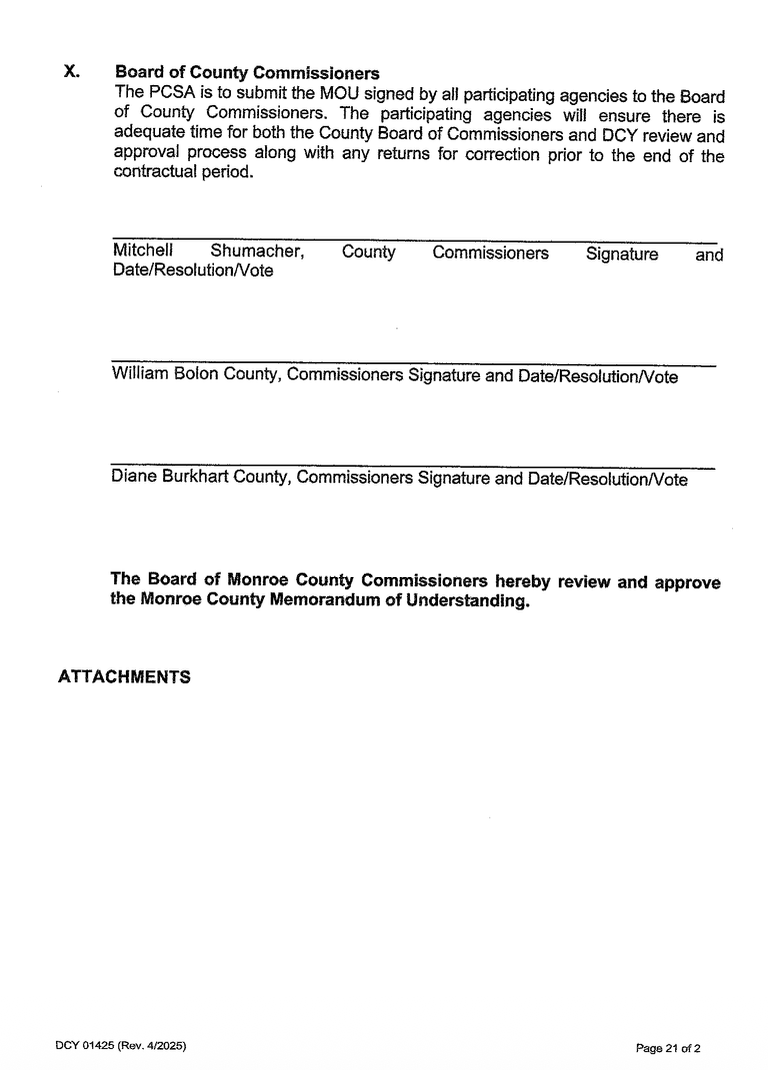
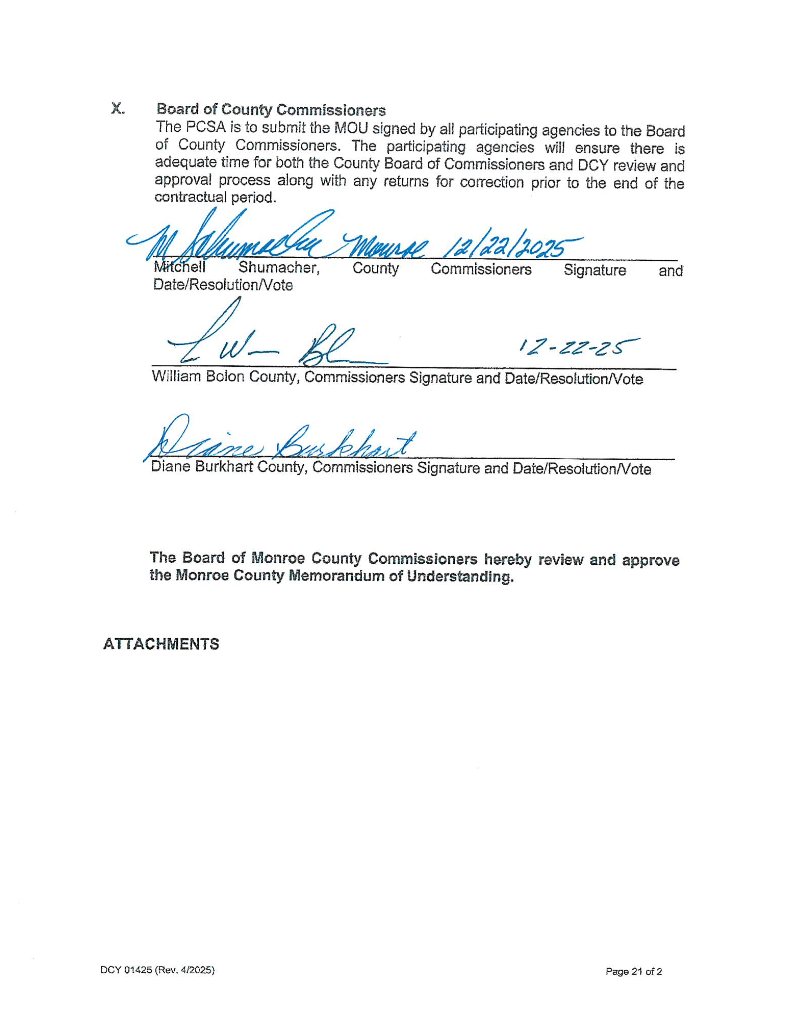
The required members are to review and evaluate the terms and conditions of the MOU every biennium. All required members to the MOU will sign the new or updated agreement. The PCSA is to submit the MOU to the Board of County Commissioners for review and approval with enough time for any revisions to be made prior to December thirty-first of the year.

This MOU does not inhibit good faith compliance with a subpoena issued by a Grand Jury or in a criminal case. Dissemination of records pursuant to the State’s discovery obligations is authorized. However, work product and other privileges are expected to be upheld.

Failure to follow the procedure set forth in the MOU by the concerned officials is not grounds for, and will not result in, the dismissal of any charges or complaint arising from any reported case of abuse or neglect or the suppression of any evidence obtained as a result of reported child abuse or child neglect and does not give, and will not be construed as giving, any rights or any grounds for appeal or post-conviction relief to any person pursuant to section 2151.4223 of the Revised Code.

This MOU will be governed by and construed in accordance with applicable state and federal laws and regulations.  Any identified or listed citations to Ohio Administrative Code revised during the implementation of this MOU are to defer to the current finalized codification.  In the event any other portion of this MOU is inconsistent with state or federal law, that portion will be without effect as if stricken from the document and the remaining portion will remain in full force and effect.

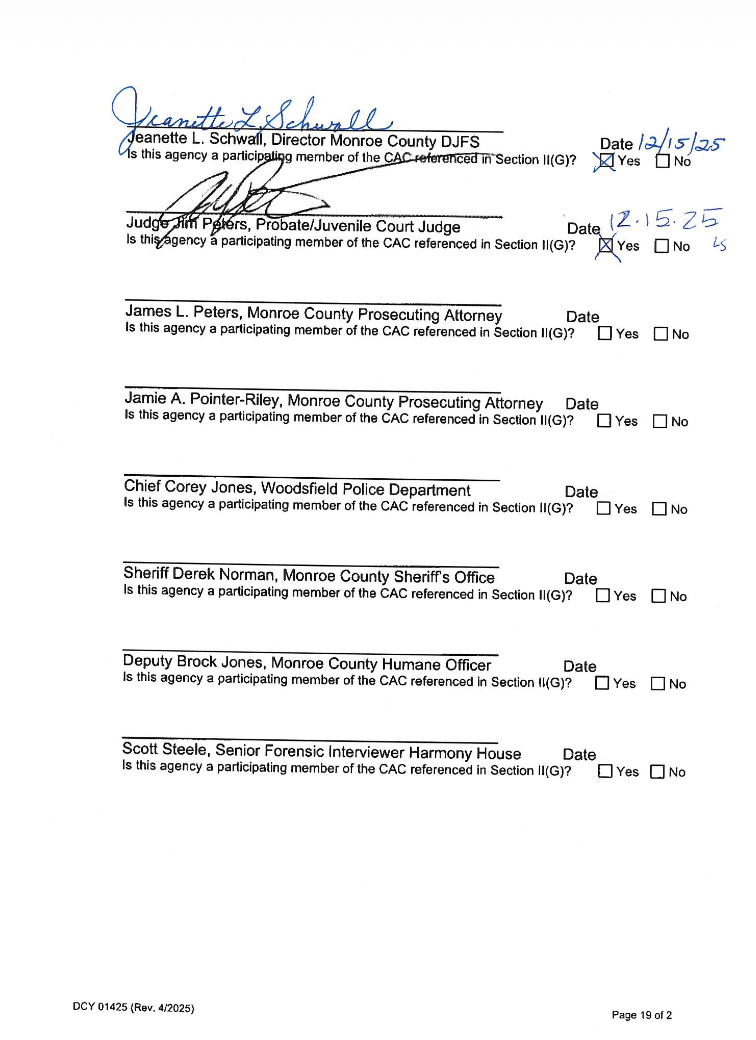
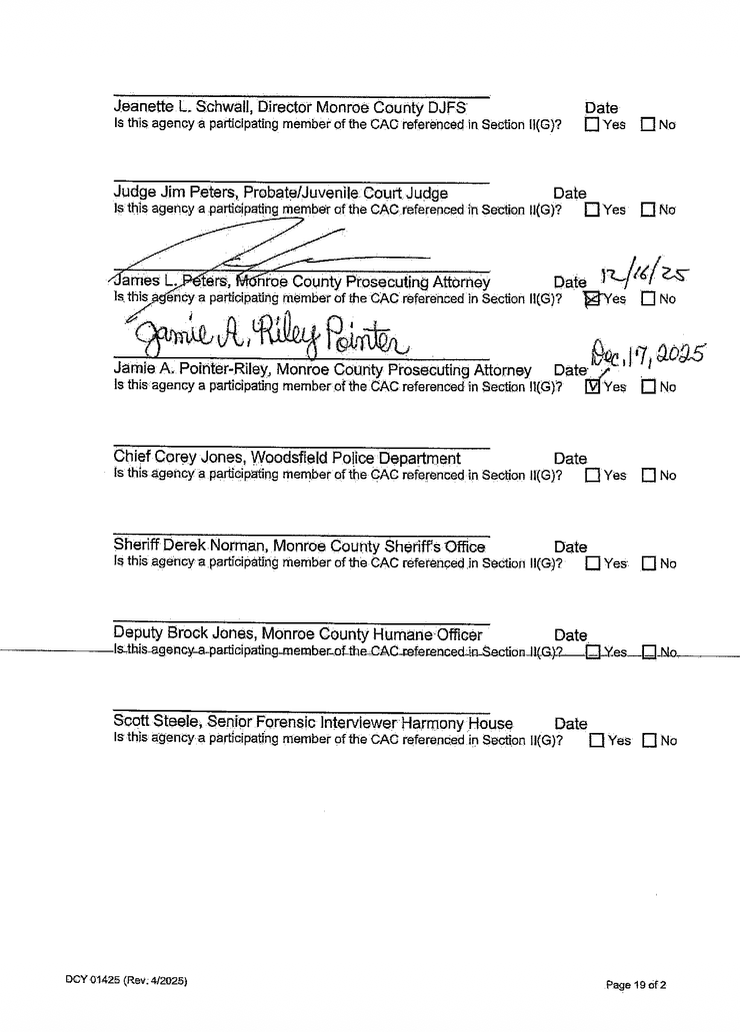
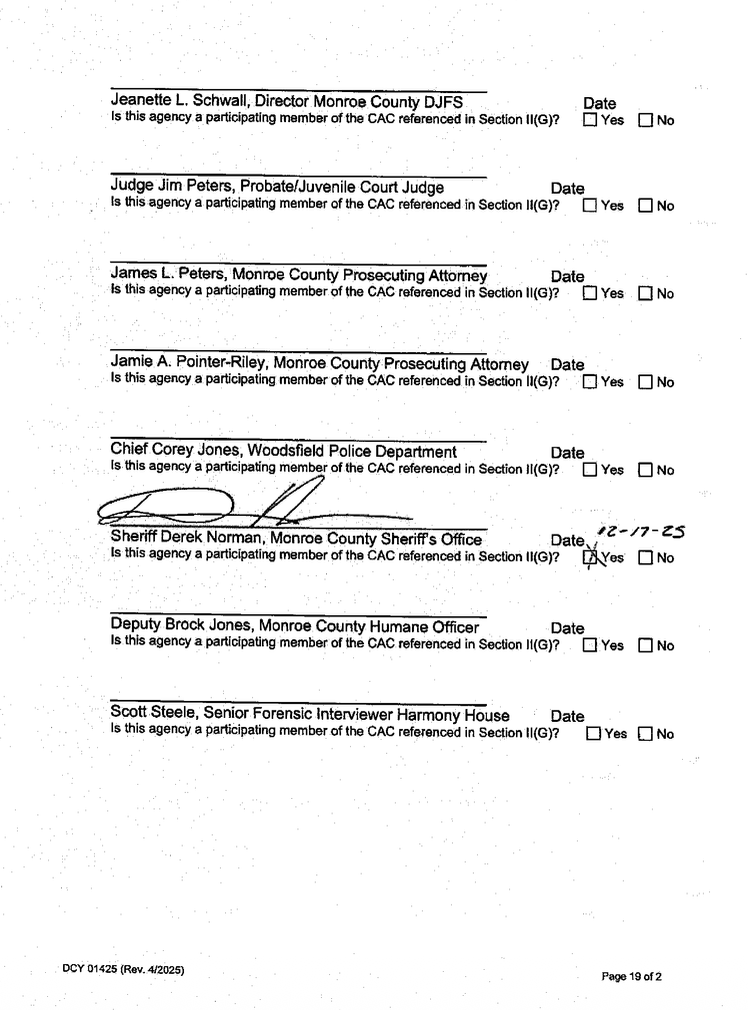
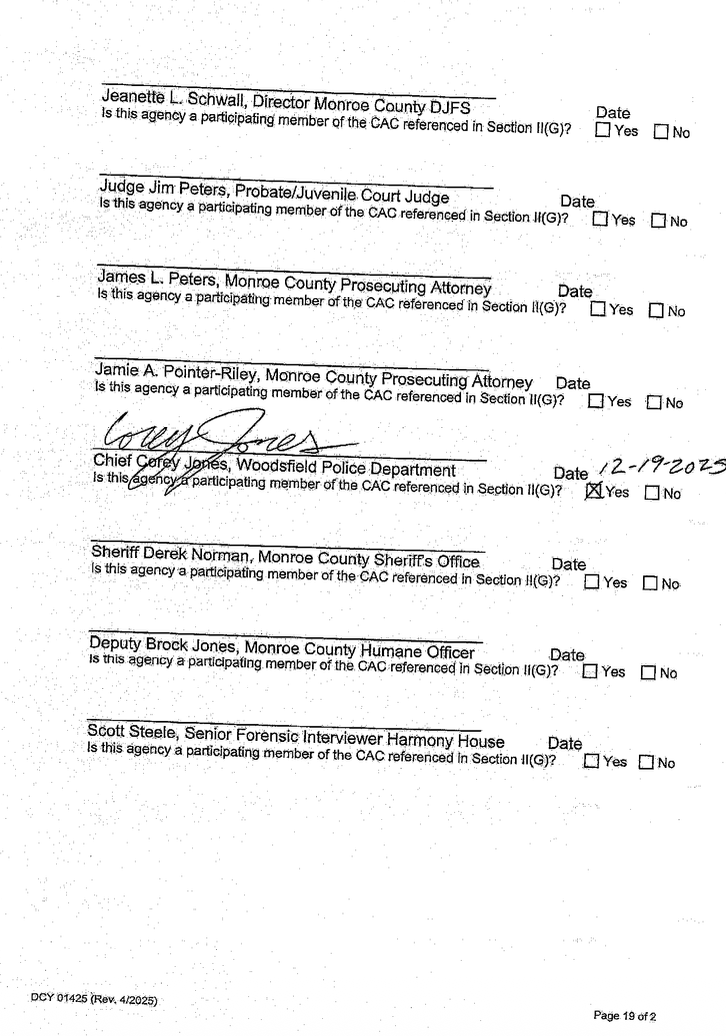
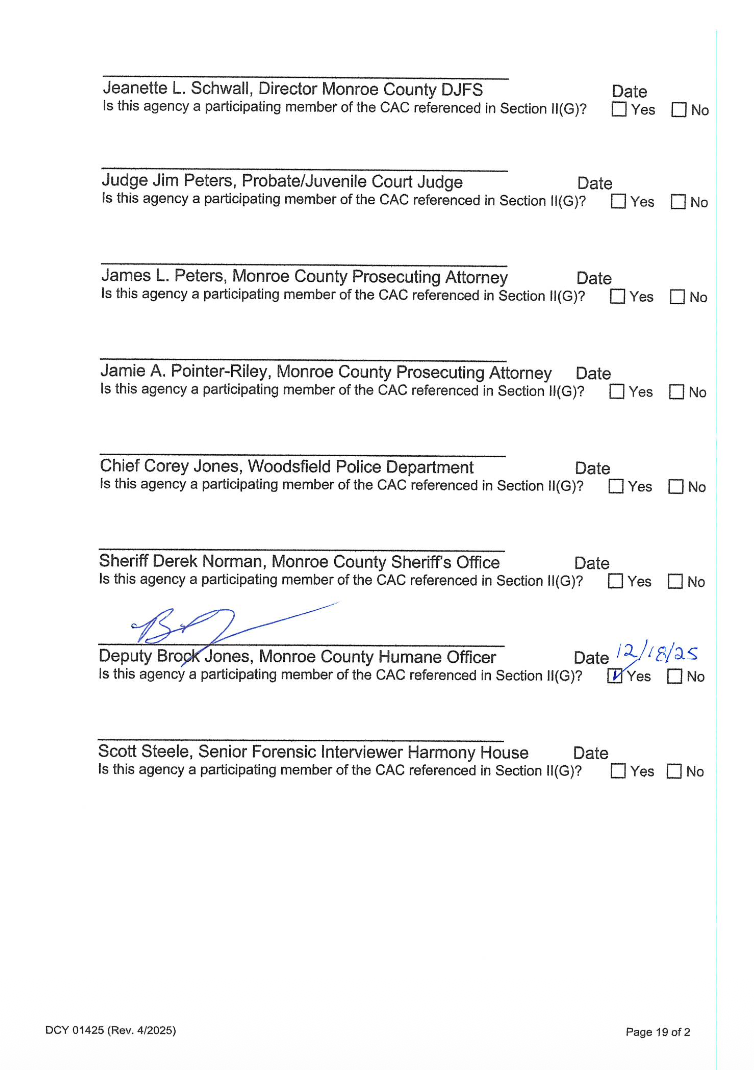
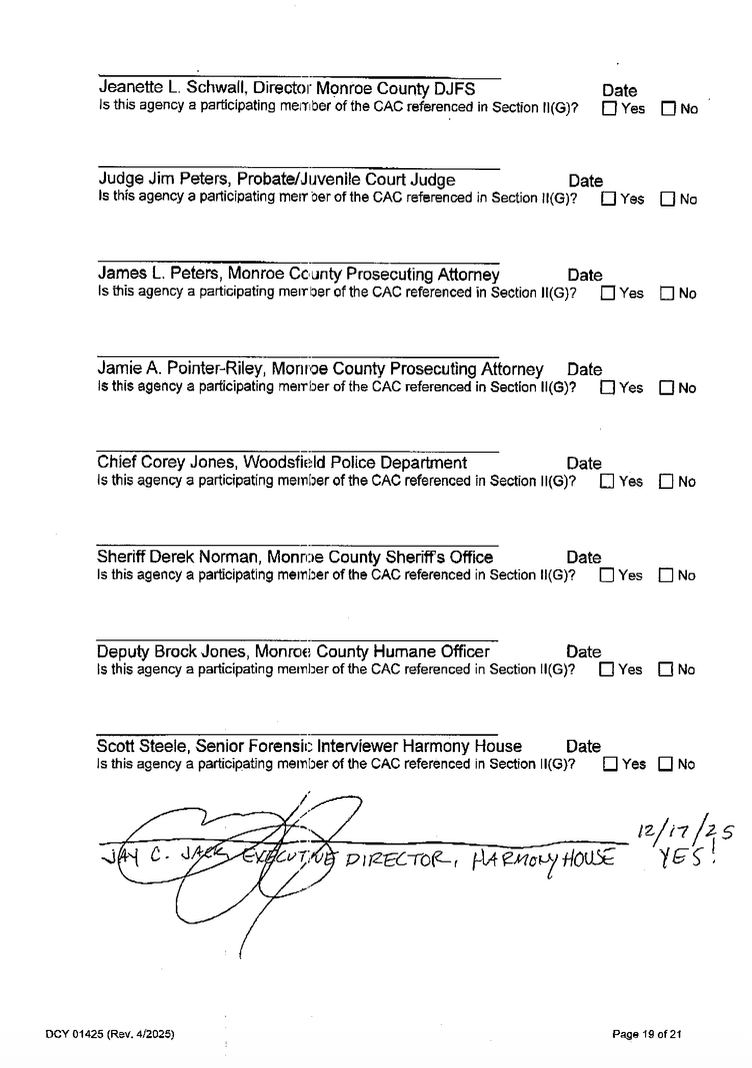
VIII. 	SIGNATURES OF EACH PARTICIPATING AGENCY

The signature section authorizes the participating parties of the agreement to begin enactment of MOU protocols and activities. The participating members agree to follow the terms of this MOU and to meet at minimum once every biennium to review terms and conditions, evaluate if updates are needed, and sign a new or amended MOU.

If any individual serving as a signatory changes mid-term, the PCSA is to provide the new required member with the current MOU. The new member remains bound by the most recently approved version of the MOU. Their signature is to be obtained.

If the PCSA participated in the execution of a memorandum under section 2151.426 of the Revised Code establishing a CAC, each participating member of the CAC is a required signatory on this MOU.

A required member to this agreement may terminate their involvement in the MOU for good cause upon giving reasonable written notice to the other required members in this MOU.

The MOU may be signed in person or electronically.
Signatures